
Adrift → Anchored
The weight of meaning in tumultuous times. Q2.

You don’t need to have read Question One before landing here. Each question in this series stands on its own and offers something worthwhile in isolation (potentially. . . thats part of why I’m posting, to gauge value. . . so please, do share feedback.)
That said, for a bit of context:
This post continues the Q&A format established in my previous piece, a dialogue between myself and Alexander Iliad.
Together, we move through 30 questions exploring themes of initiation, identity, meaning, and mattering.
My hope is that these reflections on the numerous initiatory process I guide people through act as quiet momentum, an inner nudge to help you keep moving through whatever everyday initiatory process you find yourself in right now. . . or to stop moving and drop anchor (ahem).
Question 2:
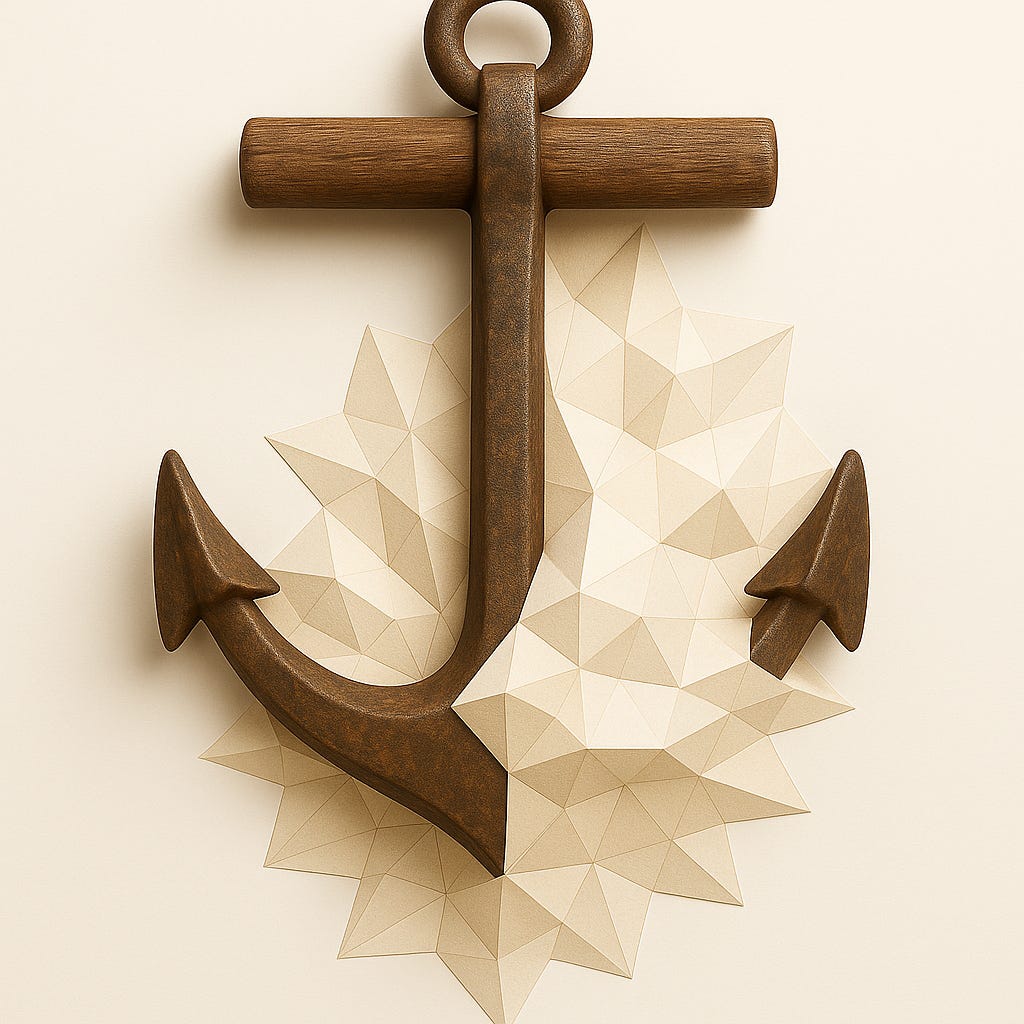
You speak often about “anchoring meaning” in a world that’s speeding up and falling apart. Let’s pause here—because anchoring is more than a metaphor. What does the anchor actually mean to you?
Answer:
When I speak about anchoring meaning, I’m pointing toward the symbol of the anchor itself. Not just as a metaphor, but as a living image—something archetypal. An anchor, in its simplest form, is a heavy object that grips the earth beneath water. It holds a vessel steady. It prevents it from being swept away by the current, the wind, the storm.
So when we talk about anchoring meaning in today’s world—a world that feels like it’s moving faster than we can track—we’re talking about that same act. The act of stabilising. Of gripping something real. Of securing ourselves when the atmosphere turns.
Because the atmosphere has turned. The weather’s turbulent. And if you haven’t already dropped anchor, chances are you’re drifting.
On a personal level, losing anchor means being disconnected from your roots—unaware of how you arrived where you are, what you’re connected to, and why that matters. Meaning gives us that anchor. It allows us to stop, to rest, to reorient ourselves. Without it, we just drift—sometimes slowly, sometimes violently—carried by forces we don’t even recognise.
If you’ve ever found yourself suddenly unsure of where you are, who you are, or how you got there—chances are the anchor was never dropped. Or maybe it was never forged to begin with. And when that moment hits, you’ll need weight. You’ll need something that can hold in the deep. Something that grips. That’s meaning.
So this image of the anchor becomes the first part of reorientation. Without it, you can’t use any of the other navigational tools—not your map, not your compass, not even your intuitive sense of direction. Anchor first. Then read the signs, use your tools. Then we can assess the depth, chart the path, choose a bearing.
In tattooing, I learned that if you want to get tattooed with intention, you have to live with intention. You can’t have a meaningful mark without a meaningful life. That’s the truth of it. Tattooing is just one link in the chain—but meaning is what joins all the links together and makes it strong.
Anchoring, in this sense, is about being tethered by that multi-link chain to something below the surface. Something substantial. Something beneath the noise, beneath the image, beneath the floaty, superficial culture we’ve come to see as normal. Anchoring means finding that thing of substance. That real solid ground. and gripping it.
Once you have done that. . . and it holds, you can move more confidently knowing you have a solid anchor.
So whether you’re drifting in the mainstream or floating in some celestial sea—whether you picture yourself on a rock hurtling through space or on the back of a cosmic turtle—the question remains: What are you tethered to? have you anchored your meaning.
And maybe you’re in the eye of the storm right now, so its ok to not be anchored. . . you are not being tested. . . But sometimes being anchored just allows you to rest. Either way, anchoring is the first act of remembrance. . . It’s the beginning of the return. It’s the beginning of orientation.
Reflection:
Anchor up or anchor down? that’s the question.
Is it time to dig your heels in, or to ladder up and out into the unknown?
Maybe the real question is: Do you have solid ground beneath you?
Something firm enough for your heels to grip… or for a ladder to retract from.
To anchor or not to anchor, depends on more than just desire. It depends on depth, weight, readiness.
Meaning still matters, even if the footing shifts.
Even if the storm is so strong that the seabed moves beneath you—
meaning matters.
MN
*A Note for Those on the Tattoo Pathway
Some of you reading this are on the Tattoo Pathway. Others may have subscribed to the research project out of curiosity, but I know there’s overlap—and I want to speak to it directly.
You may have a tattoo that once felt right, but now... doesn’t. It might still look good. It might still “make sense” on paper. But deep down, you know something’s changed.
In nautical terms, this is called a foul anchor—when the anchor becomes entangled in something it shouldn’t be. A wreck. A cable. Another anchor. Instead of holding the ship steady, it holds it back. It limits movement. It complicates recovery.
Some tattoos can do the same.
They tether us to a past self, to an old meaning or identity that no longer aligns. We stay anchored—but not in the way that steadies us. Instead, we’re snagged on something we’ve outgrown.
And here’s the key distinction:
You’re not anchored in clarity. You’re entangled in history.This is part of the work we do inside Tattoo Pathway—discerning what still holds true, and what may be keeping you stuck. Not all anchors are useful. Not all meaning stays aligned. And sometimes, what needs to happen isn’t removal—it’s realignment.
So if this resonates—if something in you knows it’s time to check your anchor—know that you’re not alone. That question is part of the Pathway too.